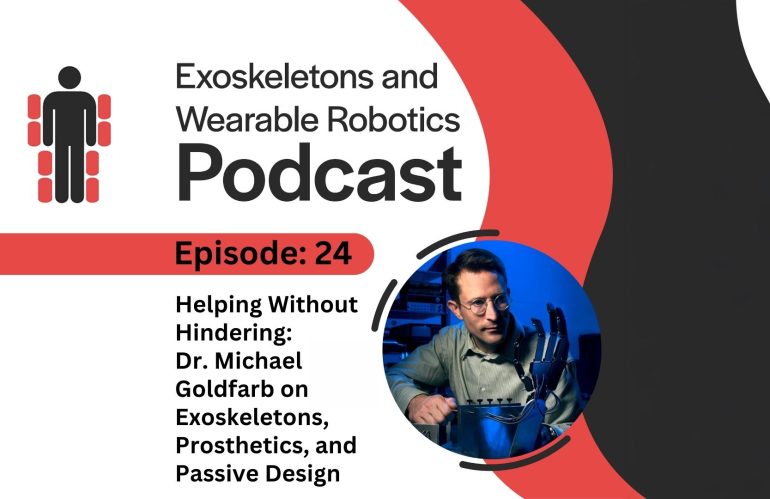
In Episode 24 of the Exoskeletons and Wearable Robotics podcast, (a joint effor by WearRA and ExR) we’re joined by Dr. Michael Goldfarb, the H. Fort Flowers Professor of Mechanical Engineering at Vanderbilt University with additional appointments in electrical engineering, computer science, and physical medicine and rehabilitation, and director of the Center for Intelligent Mechatronics. His 30+ years of work focus on wearable robotics and assistive technologies, including powered lower-limb prostheses, multigrasp hand prostheses, and the Indego exoskeleton, one of the first commercially available powered exoskeletons designed to help people with spinal cord injury and other mobility impairments stand and walk.
In this episode, Dr. Goldfarb talks with us about the evolution of prosthetics, orthotics, and exoskeletons, what it really takes for devices to “help without hindering,” and where he sees the future of wearable robotics heading.
Major Timestamps: 00:00:00 — Intro & Patreon Shout-Outs Episode welcome, Who Dr. Michael Goldfarb is, and VIP Patreon acknowledgments. 00:01:09 — Early Robotic Ankles: “Were You Really One of the First?” Asking Michael to react to the claim that he was among the first to make a successful robotic ankle. 00:02:25 — How Did You Get Into This Field? “Can you tell us about your work? What got you interested in this field?” 00:04:23 — Prosthetics, Orthotics, and Exoskeletons: Where’s the Line? Host asks how he sees the boundary between prosthetics, orthotics, medical exoskeletons, and augmentation of able-bodied users. 00:05:24 — Helping Impaired vs Enhancing Healthy Users Discussion around why the “performance bar” is different for people with disabilities vs healthy users. 00:10:29 — Naming the Field: What Do We Call These Devices? Conversation about terminology in an emerging technology field (exoskeletons, wearable robots, etc.). 00:20:29 — Where Is the Real Value Add? Question about when it’s worth adding an exoskeleton vs when existing solutions are already good enough. 00:25:44 — Swing Phase, Stumbling, and Not Getting in the Way Host asks about risks when swing assistance is high at the wrong time and how to avoid tripping users. 00:28:15 — Do Users Feel the Help? Awareness of Assistance Story of a user asking “what was that?” and discussion about whether assistance should be noticeable or invisible. 00:30:35 — Why Haven’t Powered Exoskeletons Taken Off Yet? “We expected to see tons of powered systems by now—what’s holding them back? Marketing, aesthetics, use-case fit?” 00:40:20 — Can Machine Learning Solve Exo–Human Coordination? Asking about the prospects of using machine learning to coordinate exoskeleton actions with user intent. 00:50:33 — Understanding Human Intent “How can I do that—how can I understand what the human wants?” in the context of exo control architectures. 00:57:51 — Outro
🔗 Learn more: Dr. Michael Goldfarb: H. Fort Flowers Professor of Mechanical Engineering Director, Center for Intelligent Mechatronics – https://www.vanderbilt.edu/vise/visep…
Follow this podcast
Remember to like and subscribe! You can find a summary of the full transcript and hints on how you can support this effort on the Exoskeleton Report website.