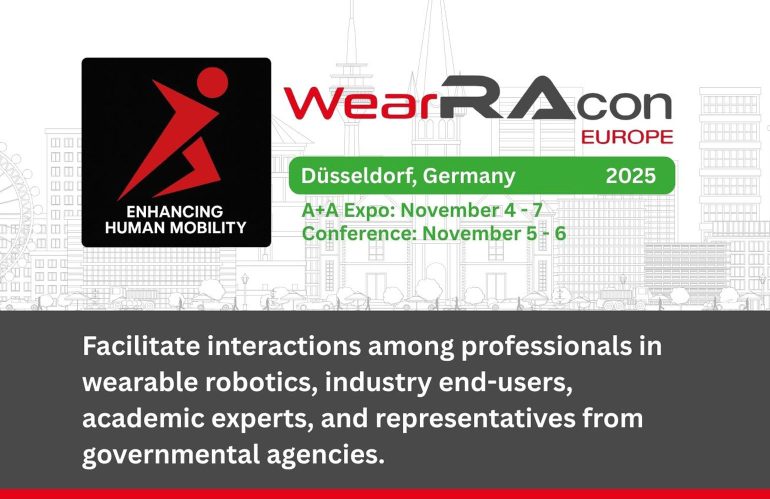
In November 2025, WearRAcon Europe returned to Düsseldorf as part of A+A, the massive occupational safety and health trade fair. Across two conference days in parallel with ExoPark and ExoWorkAthlon, occupational exoskeletons were presented not as isolated robotics demonstrations but as part of the broader worker safety ecosystem. This archive recap captures a little of what was presented, what stood out, and why the event felt like a step forward for mainstream wearable robotics (and for those who don’t feel like reading, you can try the podcast version).
For two days, the formal conference program brought together researchers, manufacturers, standards experts, ergonomists, end users, and people working on digital assessment tools. At the same time ExoPark united under one roof, occupational exoskeleton companies on the A+A show floor, and ExoWorkAthlon offered realistic work parcours where the technology could be tried, observed, compared, and discussed in a practical context. Seen together, the conference, ExoPark, and ExoWorkathlon created a rare moment for the wearable robotics field: the technology was not hidden in a robotics corner. It was placed inside the global conversation on worker safety, ergonomics, and occupational health.
The Setting: A+A and the Scale of the Safety World
The larger host event, A+A, is a huge occupational safety and health trade fair. In 2025, it ran from November 4-7 at Messe Düsseldorf, filling a large portion of the exhibition grounds. The official event framing was broad: personal protective equipment, safety systems, medical services, health at work, protective gear, human protection, and emerging safety technologies all under one roof. Hyundai Motor Group, which used the event to debut its X-ble Shoulder, reported that A+A 2025 brought together 2,340 companies from 70 countries across 13 exhibition halls and drew roughly 67,000 visitors from 150 countries.
Those numbers mattered because they changed the context for occupational exoskeletons. A visitor walking through A+A could see safety shoes, respirators, lifting devices, fall protection, chemical protection, training tools, industrial vehicles, and digital systems before arriving at the wearable robotics section (ExoPark). That setting helped reinforce a message the exoskeleton field has been trying to communicate for years: occupational exoskeletons should be evaluated as part of the worker safety toolkit, not as a futuristic curiosity.
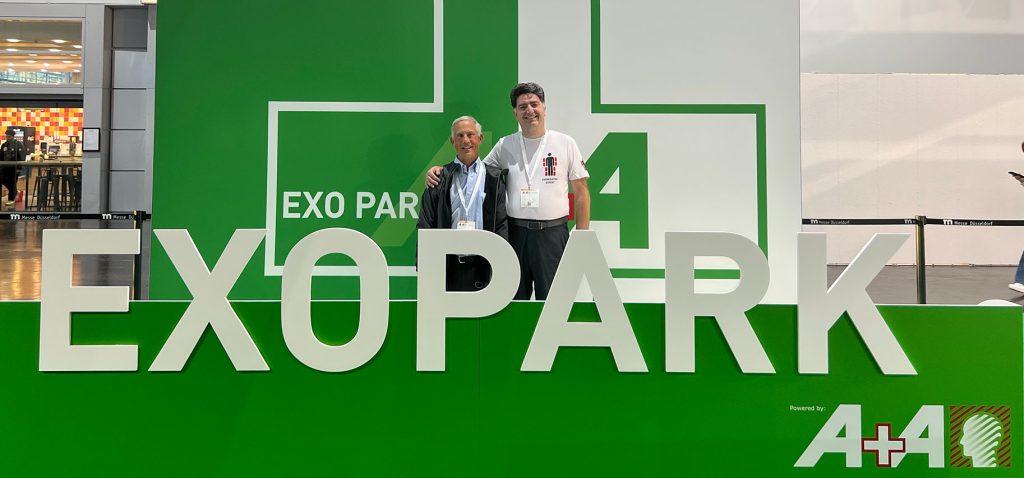
Walking the halls also made one design choice obvious. If exoskeleton companies had been scattered across the fairgrounds, many visitors would have missed them. A+A is simply too large. By clustering occupational exoskeletons in and around ExoPark, the organizers created a critical mass. Attendees could move from one device category to another, compare different approaches, ask better questions, and physically try systems without needing to search across multiple halls.
WearRAcon Europe 2025: The Conference Program
The event was organized as the European edition of WearRAcon, with Fraunhofer IPA, the University of Stuttgart’s Institute of Industrial Manufacturing and Management, and the Wearable Robotics Association closely connected to the program. The stated focus was wearable robotics in Europe, with a particular emphasis on occupational exoskeletons. A new feature for the 2025 edition was the inclusion of digital ergonomics tools and an overview of how those tools can support exoskeleton deployment and workplace design.
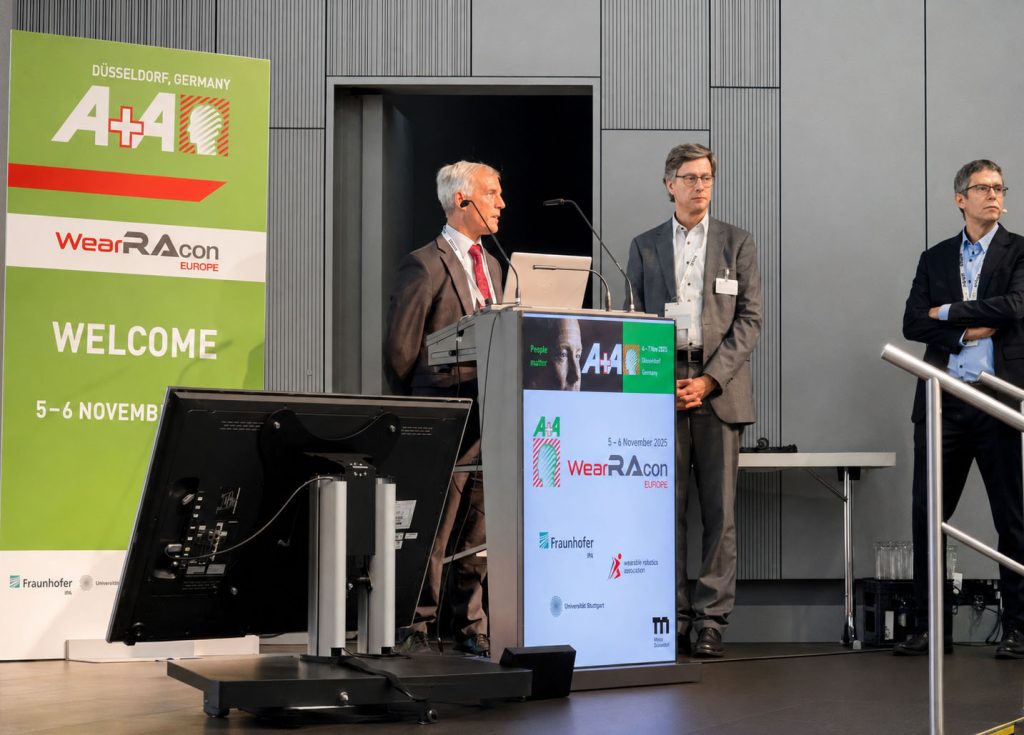
That theme was visible throughout the agenda. Day 1 opened with welcoming remarks from Christophe Maufroy, Dr. Thomas Sugar, and Dr. Urs Schneider, followed by a keynote from Prof. Massimo Sartori on generalizable human-robot interfacing and bio-protective robotic technologies. One of the interesting ideas from that keynote was the possibility of systems that do more than assist a single motion. A future exoskeleton may need to detect load, task phase, and user context, then adapt its support across lifting, carrying, holding, and walking.
The first day also included sessions on exoskeletons and exosuits technologies, contributed talks, exoskeleton evaluation and studies, user acceptance, and a poster session. The poster session deserves mention in an archive recap because it represented the field’s next generation. Students and researchers brought a wide range of ideas, and even when there was not enough time to cover every project in a full talk, the posters gave the community a way to preserve and discuss work that might otherwise disappear after the event. For more information and the posters, please see the Proceedings of the 4th WearRAcon Europe Conference.
Day 2 leaned more toward application, implementation, digital ergonomics, and evidence. The morning keynote by Urban Daub focused on data-driven and digital ergonomics tools. For occupational exoskeletons, this is becoming increasingly important. It is useful to know whether a worker likes a device, but successful deployment also requires objective data: what the task demands, how loads change, whether posture improves, where fatigue is reduced, and how work differs with and without an exoskeleton.
The end-user forum and later technical sessions extended that theme. Talks covered organizational integration, field evaluation, practical nursing training, construction, standards, guidelines, and long-term evidence. The agenda included discussion of Eso-EAWS 2.0 certification and ASTM standards, as well as the HeroWear closing presentation by Dr. Mark Harris on the evidence and ROI case for exosuits. One consistent thread was the need to make claims clearer and easier to compare. As the field matures, the industry needs better evidence, more standardized language, and more long-term reporting from real deployments.
ExoPark: Critical Mass on the Show Floor
If the conference rooms provided the scientific and implementation discussion, ExoPark provided the physical demonstration. An additional value was their presence together. The cluster included more than twenty exoskeleton producers, plus related organizations working on sensors, digital assessment, and support technologies. That changed the visitor experience. Someone could see passive shoulder systems, back-support exosuits, powered hip systems, chairless-chair concepts, elbow or hand-support ideas, digital assessment tools, and sensor platforms in a single area.
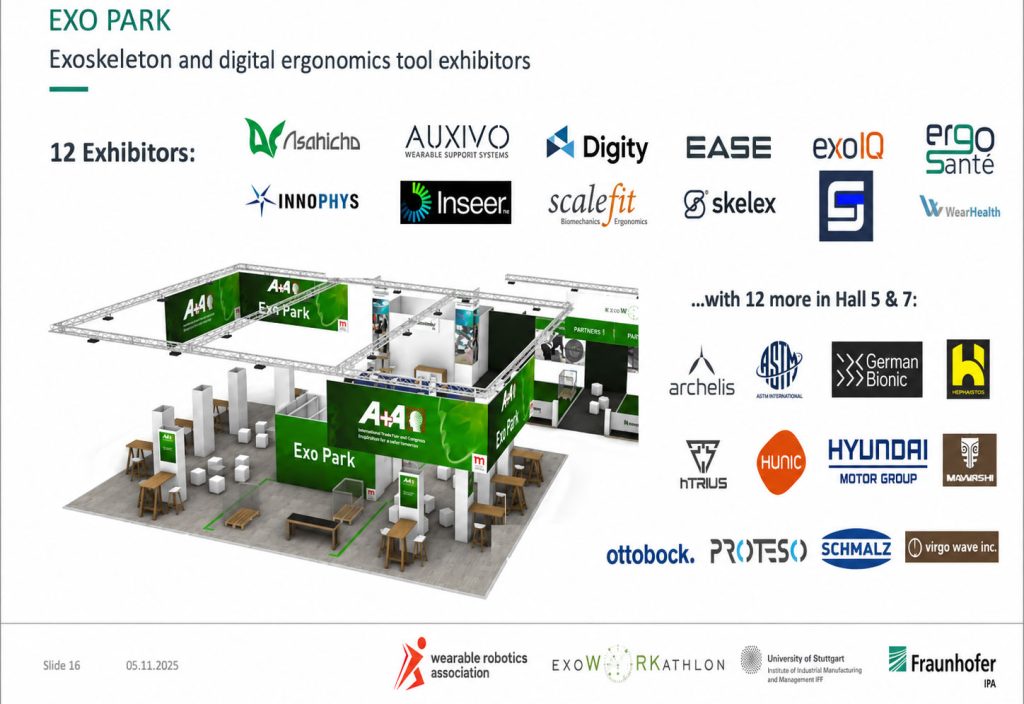
(Above). The companies at ExoPark 2025: Asahicho Corporation, Auxivo, Digity, EASE, exoIQ, ErgoSanté, Innophys, Inseer, scalefit, Skelex, ULS Robotics, WearHealth, archelis, ASTM International Exo Technology Center of Excellence, German Bionic, HeroWear, hTRIUS, HUNIC, Hyundai Motor Group, Mawashi, Ottobock, Proteso, Schmalz, and Virgo Wave.
That kind of clustering helps demystify the technology. It makes it easier for an ergonomist, safety professional, insurer, plant manager, or worker representative to understand that “exoskeleton” is not one single product category. There are different devices for different tasks, body regions, support profiles, and implementation constraints. Seeing those options side by side makes the technology feel more like a product family and less like a one-off demonstration.
Hyundai Motor Group’s Robotics LAB provided one of the most visible examples of how large companies are now presenting this technology. Their X-ble Shoulder booth was located in Hall 5, the Wearable Robot Zone, and Hyundai described it as a 208-square-meter space for product display, fitting, trial, and consultation. The experience included hands-on overhead work activities, utilizing tools used against a ceiling-mounted touchscreen. That type of demonstration matters because shoulder support is easiest to understand when the user feels the difference during a realistic overhead task.
ExoWorkAthlon:
ExoWorkAthlon develops work-specific parcours (use-case examples) for industrial exoskeletons, with the goal of demonstrating and discussing device function in relation to user feedback, ergonomics, metabolic considerations, and production quality. In other words, the work task comes first, and the exos are tested as a family of devices.
That matters because real workplaces often do not allow perfect ergonomic solutions. In a classroom, it is easy to say, “lift with your legs” or “use a lift assist.” In a real logistics task, a deep crate may prevent good knee bend. In a nursing task, patient handling may involve tight spaces, awkward angles, and movement that does not resemble a clean gym lift. In some cases a crane, lift table, or two-person lift may not be available, practical, or sufficient. Exoskeleton evaluation becomes much more meaningful when it starts from these constraints.
At A+A 2025, the ExoWorkAthlon area included nursing and logistics-oriented scenarios. The nursing station used a medical bed and a full-body patient dummy to simulate patient mobilization and transfer tasks. The logistics station included crate-based lifting and handling tasks, including boxes and weighted bags. These scenarios were designed around real use cases where bending, lifting, holding, and repositioning can be difficult to avoid.
Dr. Urs Schneider and the Fraunhofer IPA team deserve credit for continuing to push this applied, use-case-driven approach. The most valuable demonstrations are not always the most spectacular ones. Often, the most useful demonstration is a controlled, repeatable work scenario that lets end users ask: What does the device do here? What does it not do? How does it affect movement? How does the worker perceive it? What happens over time?
A Better Educated Audience
One of the biggest differences we noticed was the level of awareness among attendees. Many visitors were not encountering occupational exoskeletons for the first time. They arrived with better questions. Some had seen devices before, had heard about pilot projects, or understood that the best way to evaluate a device is to put it on and try it against a realistic task.
That is a meaningful shift. In earlier years, much of the conversation around occupational exoskeletons focused on explaining what the technology was and correcting misconceptions. Those conversations still happen, but at A+A 2025, there was also a stronger sense of practical evaluation, with visitors having seen the devices online and now looking forward to physically putting them on.
Looking back, WearRAcon Europe 2025 and ExoPark at A+A should be remembered as more than a busy event week. They captured a point in time when occupational exoskeletons were increasingly being presented as normal safety and ergonomics tools. Not common yet, and not simple, but increasingly understandable.
That is the direction the field needs to move. The goal is not for exoskeletons to remain exotic. The goal is for workers, safety managers, engineers, ergonomists, researchers, insurers, and employers to understand when they are appropriate, when they are not, how to evaluate them, and how to implement them responsibly. In the long run, the technology should become less mysterious and more practical, closer in spirit to safety glasses, hard hats, safety shoes, or other protective equipment used when the task calls for it.
The 2025 event showed several indicators that this transition is underway. Companies invested in larger and more professional booths. Researchers and standards groups discussed evidence and comparability. End users were represented in the conference program. The ExoWorkAthlon continued to frame testing around actual tasks. Visitors were more prepared. And the broader A+A setting placed exoskeletons inside the mainstream safety conversation.
Links:
- Episode 29 Podcast Recap: https://exoskeletonreport.com/2026/06/episode-29-wearracon-europe-2025-big-booths-big-energy-and-exopark-at-aa/
- WearRAcon Europe official page: https://www.wearraconeurope.de/en/wearracon-Europe.html
- WearRAcon Europe 2025 agenda: https://wearablerobotics.com/2025-agenda-2/
- Proceedings of the 4th WearRAcon Europe Conference: https://eprints.soton.ac.uk/507684/1/Proceedings_WearRAcon_Europe_2025_final.pdf
- ExoWorkathlon about page: https://www.exoworkathlon.de/en/about-exoworkathlon.html
- Hyundai Motor Group Robotics LAB at A+A 2025: https://www.hyundaimotorgroup.com/en/story/CONT0000000000196927
- HeroWear closing presentation, “3 Keys to Mainstreaming Exoskeletons in the Next Five Years”: https://www.youtube.com/watch?v=MDoksEYHGbA&t